
Guide
How does kitchen wrapping work?
Kitchen wrapping follows a set sequence: measure, remove handles, degrease, sand and prime where needed, apply the film tightly, finish edges and corners neatly, and refit everything. The whole process is usually done in 1 to 2 days — no demolition, no weeks without a kitchen. The secret isn't the film itself, it's the preparation: a large share of cases where film lifts too early trace back to a poorly prepared surface. Below we walk through every step so you know exactly what happens.
Step 1 — Measuring and assessment
We start with a free on-site measure at your home. We assess the condition of your fronts, panels and the existing finish, and check whether anything needs attention first — loose edges, old film or damage. That way we know exactly what's needed, and your fixed price is right from the start. Is a component damaged? In our own workshop in Creil we can often repair it first.
Step 2 — Removing handles and hardware
Handles, knobs and, where practical, doors and drawers come off. That gives clean access to the edges and corners — exactly where the result is made. Everything is labelled so it goes back precisely where it belongs.
Step 3 — Degreasing (the most important step)
This is the step that decides the end result. A kitchen is full of an invisible layer of grease, steam and fingerprints. Bond film onto that and it will lift sooner or later. So we degrease thoroughly and wipe the surface down with alcohol (IPA), which also removes silicone and any last traces of grease. Only when the surface is truly clean and dry do we go on.
Step 4 — Sanding and priming where needed
Where the film needs extra grip, we sand lightly. Porous areas — such as untreated MDF — and vulnerable edges get a primer, an adhesion promoter that keeps the film in place even in tricky spots. Not every surface needs this; we do it where it makes a difference.
Step 5 — Applying the film
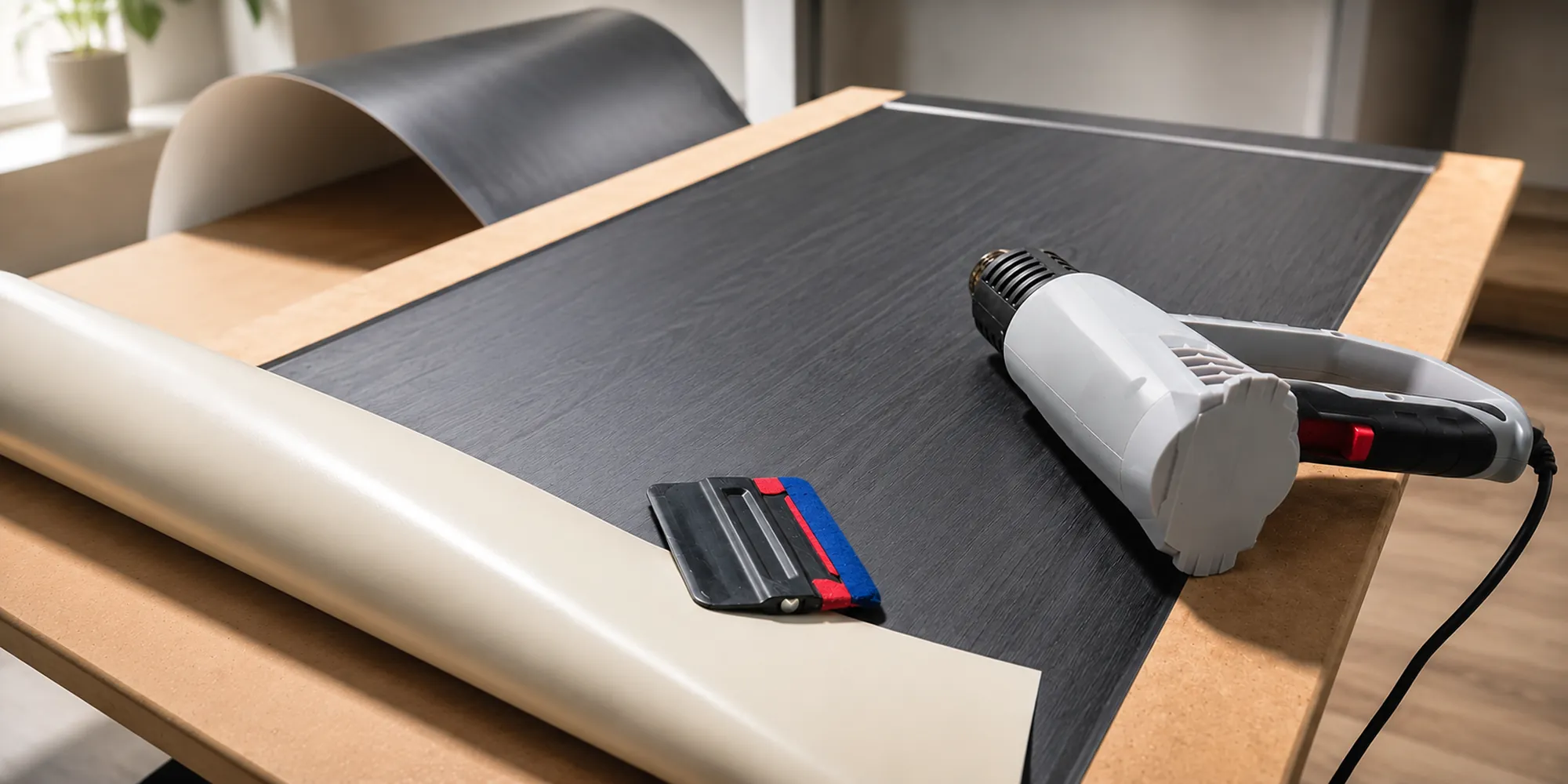
Now comes the craftsmanship. The film is aligned — for woodgrain and stone looks the pattern runs continuous, so it reads as one whole rather than a set of separate pieces. We drive out the air with a squeegee and use controlled heat so the film forms around the shapes of the front. Calmly, from one side to the other, with no bubbles or creases.
Step 6 — Edges, corners and recesses
This is where craftsmanship separates from rushed work. Edges, corners and recessed framed fronts take patience: the film is laid neatly into and around the shapes and finished tight. Where a seam is unavoidable, we place it in the least visible spot. This is the detail you see up close — and it decides whether a kitchen looks crisp or messy.
Step 7 — Refitting and checking
The handles and doors go back on, we check that everything hangs and closes straight, and we go over the kitchen for details. After that you can use it straight away: no drying time, no waiting.
Why preparation makes the result
If there's one thing we want you to take away: film that bubbles or lifts is almost never a problem with the film itself. It's almost always a matter of preparation — degreasing, priming, the edges. A kitchen is the place with grease, steam and heat; only a properly prepared surface survives that. That's why we take the time those steps deserve.
And afterwards? Care and guarantee
A wrapped kitchen is easy to keep clean with lukewarm water and a mild cleaner — no aggressive abrasives. With normal use, quality film lasts for years, with up to 10 years' guarantee depending on the chosen film. If one front does get damaged, we usually replace just that front.
Ready to start?
Already know your kitchen is suitable? Calculate your fixed price straight away. Not sure whether your kitchen is a good candidate? Read our article on Can my kitchen be wrapped?, or send us a few photos via WhatsApp and we'll tell you honestly whether it can be done. Calculate your fixed price
Frequently asked questions
How long does wrapping a kitchen take?
Usually 1 to 2 days, depending on the size and the condition of the fronts. You can use the kitchen straight afterwards; there's no drying time.
Do I need to empty my kitchen?
You don't need to empty the cabinets, but clear loose items and small appliances off the worktop so we can work freely.
Can I stay home during the wrapping?
Yes. There's no demolition and barely any dust or disruption; you can simply stay home.
Why is degreasing so important?
Because film on a greasy or dirty surface lifts sooner or later. A large share of cases where film fails come down to insufficient preparation.
Wondering what wrapping would cost for your kitchen?
No vague quote — calculate your own fixed price per component, including VAT and travel costs.
Calculate your fixed pricePrefer a call back?
Call me back