
Guide
Wrap your kitchen, or buy a new one?
If your kitchen is still technically sound and it's only the look that bothers you, wrapping is almost always the sensible choice: your existing fronts and panels get a smooth interior film, you're done in 1–2 days, and you pay a fixed price you calculate yourself up front. A new kitchen in the Netherlands costs on average €12,000 to €20,000 including installation, and typically takes 6 to 12 weeks. But if the layout no longer works, the cabinets themselves are damaged, or you want different appliances, wrapping won't fix that — and a new kitchen is the better investment. So the real question isn't 'which is better', it's: is the problem the look, or the kitchen itself?
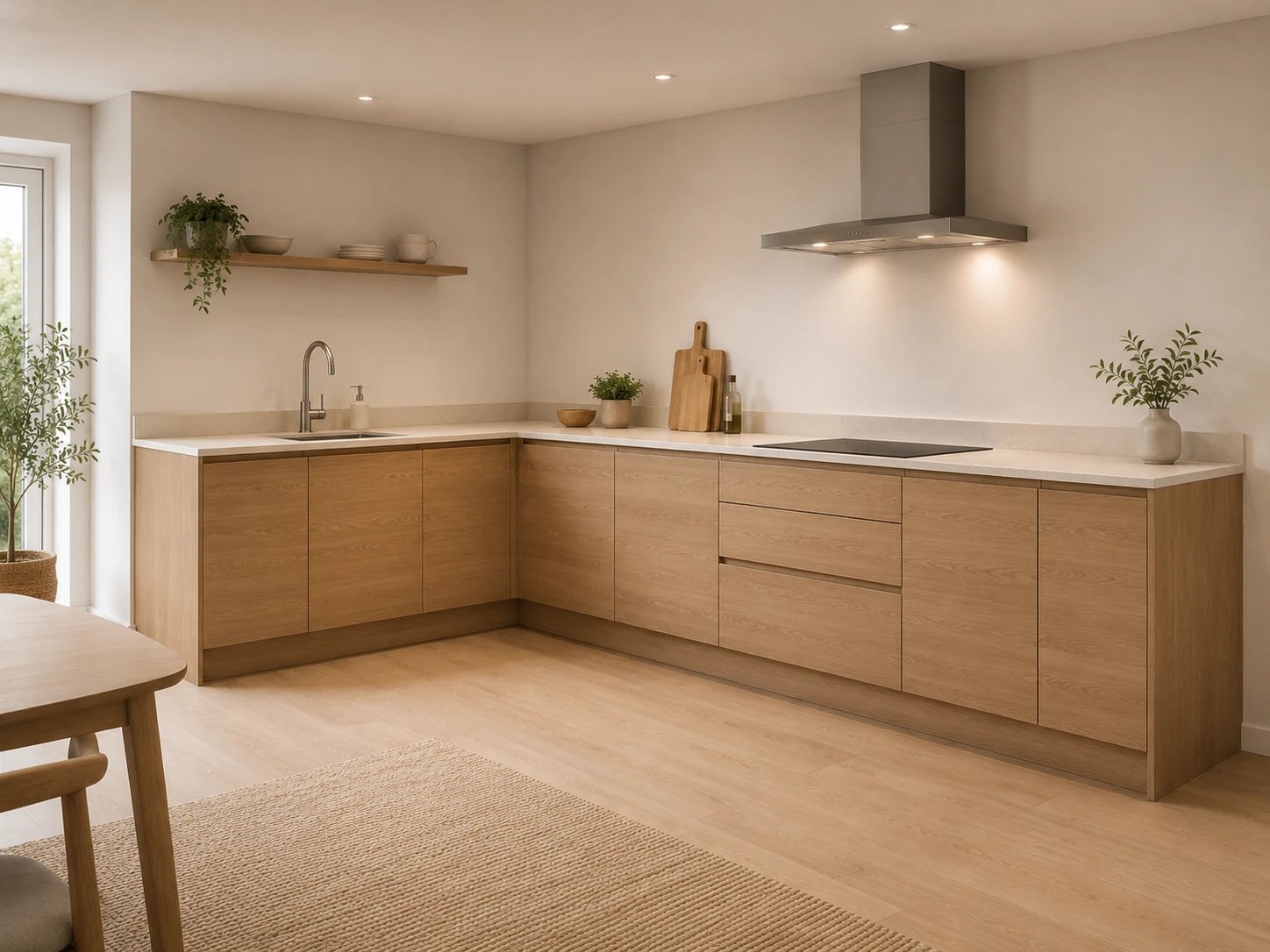
In short
Wrapping
Fast & affordable
- Existing kitchen stays
- Done in 1–2 days
- Fixed price, calculate it yourself
- No demolition or waste
- Up to 10 years' guarantee
- Only if the kitchen is technically sound
New kitchen
Complete, but time-consuming
- Everything is replaced
- 6–12 weeks lead time
- €12,000–20,000 average incl. installation
- Demolition, pipework, floor repair
- New layout and appliances possible
- Needed if cabinets are damaged or the layout fails
What are you actually replacing?
With wrapping, your kitchen stays put. The carcasses, the layout, the drawers, the plumbing and your appliances all stay as they are. What changes is the visible layer: fronts, doors, side panels, plinth and optionally the worktop get a new, even film. With a new kitchen you replace everything — including the parts that may still work perfectly well. That difference explains almost the entire gap in price and time.
What it costs: wrapping versus a new kitchen
A new kitchen is a substantial investment in the Netherlands. Entry-level kitchens start around €5,000 to €7,000, most households end up between €12,000 and €20,000, and with bespoke work or an island it climbs past €30,000. Installation is usually on top (€1,500 to €3,000), as is moving pipework and electrics (€1,500 to €3,500) and repairing the floor where the old units stood (€500 to €2,000). A full replacement including demolition typically runs €18,000 to €30,000 in the mid-segment.
Wrapping sits in a completely different order of magnitude. At Super Keuken Wrap you pay a fixed price you calculate yourself, per component — per front, per panel, per metre of plinth or worktop — including VAT and travel within our service area. No vague quote, no surprise invoice; there is a minimum of €300 including VAT. Calculate your fixed price
Lead time: days versus weeks
This is the part people underestimate most. A new kitchen usually takes 6 to 12 weeks from design to completion, mostly because of appliance and worktop delivery times. During the works you can't use your kitchen: demolition, dust, pipework, waiting on parts.
A wrap is finished in 1 to 2 days. No demolition, no building waste, no weeks without a kitchen. You're cooking again the same week — in a kitchen that looks new.
When is a new kitchen genuinely the better choice?
To be fair: wrapping doesn't solve everything. Choose a new kitchen if:
• the layout no longer works — you want an island, different work triangles, more storage;
• the cabinets themselves are damaged — sagging bases, water damage, broken hinges or drawers;
• your appliances need replacing anyway and you want to redo the whole thing;
• your fronts are badly damaged or heavily warped — film follows the surface underneath; it does not hide structural damage.
In those cases we say so plainly. We'd rather wrap nothing than wrap something that causes problems later.
Not sure if your fronts qualify? Run the check in our article on can my kitchen be wrapped.
When is wrapping the smart choice?
Wrapping is at its best when your kitchen is technically fine, the layout works and your appliances are still good — but the colour or style feels dated. Think high-gloss fronts from a previous era, or a colour that no longer suits your interior. You get an even, factory-like finish in woodgrain, matt, concrete look or a solid colour, with up to 10 years' guarantee depending on the chosen film. See our films
What about sustainability?
A kitchen that stays put doesn't have to be demolished and hauled away. With wrapping, the entire cabinet frame stays in use and only the visible layer is renewed. If you'd rather not see a technically sound kitchen end up as bulk waste, that's a serious argument.
How to choose
Ask yourself one question: is it the look that bothers you, or the kitchen itself? If it's the look and everything else works, wrapping is faster, cheaper and far less disruptive. If the kitchen itself no longer works, a new one is worth the investment — even at the higher price. Not sure? Calculate your fixed price for wrapping and put it next to a kitchen quote. You'll see at a glance what makes sense for your situation. Calculate your fixed price
Going with wrapping? Read our article on choosing a kitchen wrapper: what to look for too.
Frequently asked questions
Is wrapping really cheaper than a new kitchen?
Yes, usually by a wide margin. A new kitchen in the Netherlands averages €12,000 to €20,000 including installation; with wrapping you calculate a fixed price per component yourself, with a €300 minimum including VAT.
Can I wrap only the fronts?
Yes. You choose per component: just the fronts, or also side panels, plinth, worktop and the underside of wall units.
How long does wrapping take?
Usually 1 to 2 days, depending on scope. A new kitchen typically takes 6 to 12 weeks.
What if my kitchen is damaged?
We prepare minor damage. With structural damage — sagging bases, water damage, broken hinges — wrapping is not the right solution, and we'll tell you so.
Wondering what wrapping would cost for your kitchen?
No vague quote — calculate your own fixed price per component, including VAT and travel costs.
Calculate your fixed pricePrefer a call back?
Call me back